
“Touch seems to be as essential as sunlight.” — Diane Ackerman
There is a particular kind of intimacy that doesn’t announce itself. It doesn’t knock. It doesn’t clear its throat politely. It just… happens. Or it doesn’t. And somehow our bodies clock it immediately, while our minds are still busy pretending everything’s fine.

Touch in relationships is often discussed in pieces, like an over-organised drawer: sex in one compartment, affection in another, routine shoved somewhere at the back. But intimacy doesn’t live in neat sections. It’s layered. It overlaps. It spills. And most of the time, it begins quietly — almost shyly.
Sex is an essential part of that picture. Not as a dramatic headline or a performance review (“overall enthusiasm: satisfactory”), but as a living, breathing connection between two people. Regular sex matters because it keeps couples communicating — sometimes with words, sometimes with sighs, sometimes with nothing but a look that says, yes, that, exactly that.
Over time, couples don’t just share a bed; they learn each other. What feels good. What feels safe. What used to work but doesn’t anymore. What needs more attention. Love, in this sense, isn’t static — it’s more like learning a language together, complete with mispronunciations, misunderstandings, and the occasional moment of fluency that makes you think, oh, so this is what it’s supposed to feel like.
That kind of physical intimacy builds trust. It requires presence. You can’t fully check out mentally and still connect that way — at least not for long. And when sex disappears for extended periods, it’s rarely just the physical side that suffers. Distance has a habit of spreading, quietly and efficiently, like mould in a corner no one wants to look at too closely.
But intimacy doesn’t begin or end in the bedroom.
Alongside sex — supporting it, sustaining it, softening it — live the smaller, quieter touches. The brush of skin while passing each other in the hallway. Fingers grazing “by accident” and lingering very much on purpose. A hug from behind in the kitchen while something’s cooking and someone’s pretending they’re not enjoying it more than they should.

There is power in these touches — in fondling that isn’t rushed or goal-oriented. Hands resting, exploring, holding, absentmindedly touching one another as if to say, I’m here, you’re safe, we’re okay. This kind of contact calms the nervous system in ways conversation often can’t. It slows the breath. It lowers defences. It tells the body it can stand down.
These moments don’t compete with desire. They keep it alive.
They remind the body that closeness isn’t something you book into the calendar. That affection isn’t conditional. That being wanted doesn’t require a special occasion or perfect timing. They’re the emotional equivalent of background music — you don’t always notice it, but you absolutely feel it when it stops.
Fondling carries a particular kind of joy. There’s something deeply human — almost playful — about touching someone you love simply because you want to. It’s welcome in private, and often quietly present in public too: a hand at the small of a back, fingers interlaced, a thumb gently stroking skin where no one else is looking. Not obvious. Not performative. Just intimate.

A hand resting on a knee during a drive. An arm draped casually over a shoulder on a walk, as if it belongs there — because it does. Stopping mid-street to place a soft kiss on a forehead, a cheek, the corner of a mouth. None of it dramatic. None of it Instagram-worthy. All of it deeply felt.
The thumb tracing absentminded circles on a knee, the arm slung over a shoulder like it’s always lived there — a quiet you’re mine and I’m here, without the need for a speech.
These moments are small. Almost forgettable. And yet when they disappear, the absence echoes — like suddenly realising your phone’s been on silent all day and no one’s tried to reach you.
For some couples, that disappearance is the first quiet sign that something deeper isn’t aligned. Not because anyone failed. Not because someone didn’t try hard enough. Simply because not every connection is meant to carry this kind of closeness — and forcing it rarely ends well.
A kiss during the day, ot the dramatic, movie-ending kind, but the “I’m still present” one, stolen between errands, meetings, or emotionally loaded WhatsApps, does something even more dangerous: it interrupts the noise. It says, I see you outside of obligation.
For women, those touches often whisper reassurance — that they’re wanted, desired, still interesting beyond logistics and shared calendars. For men, they quietly affirm something just as fragile: that desire hasn’t cooled, that affection hasn’t expired, that familiarity hasn’t dulled attraction — that she still wants to be touched and loved.
Neither side admits how much this matters. We like to act evolved about it. We’re not. Even New Girl understood this instinctively — where affection was messy, awkward, constant, and deeply reassuring. Touch, like humour, is often how people say what they can’t quite articulate.

Holding hands while walking — even briefly, even awkwardly — signals partnership without performance. It’s not about passion; it’s about presence. About choosing closeness in public without needing an audience. No grand gestures. No background music swelling. Just two people saying, yes, this is us.
Fondling has a quiet way of dissolving tension. A hand on an arm mid-argument. Fingers lacing together when words start sharpening. Touch doesn’t erase disagreement, but it can soften it — reminding both sides that connection exists underneath the frustration. Sometimes it’s the only thing that stops an argument from becoming a standoff.
Skin-to-skin contact does something words rarely manage. It calms the nervous system. It signals safety. It lets the body exhale in a way the mind often can’t. There’s comfort in being touched without expectation — without escalation, explanation, or outcome. Just closeness, like resting your head against a wall after a long day.
And when it’s there, consistently, we barely notice it.
When it’s gone, we feel it everywhere.
Sometimes that absence isn’t something to fix, but something to understand — a sign that two people may be trying to build intimacy on foundations that were never meant to hold it. Like trying to force chemistry where there’s only politeness.
The absence of physical intimacy doesn’t always arrive with conflict. More often, it slips in quietly — through tiredness, stress, resentment left unsaid. Touch becomes hesitant. Sex becomes irregular, then rare, then something everyone avoids mentioning, like a broken step you keep stepping around.
The craving that follows isn’t always sexual. Often, it’s a longing for reassurance. For proof of place. For that quiet confirmation that says, I’m still here with you.
Physical intimacy grounds us in our partner’s world. It reassures us not just of attraction, but of belonging. It says, you matter to me beyond words. As Sex and the City once put it, sometimes love is less about grand gestures and more about who reaches for you when things go quiet.

There is something unmistakable about physical intimacy when two people know they are meant for one another. Not fireworks. Not destiny speeches. Just a calm certainty that settles in the body. Communication flows. Silence feels safe. The relationship feels effortless at its core — even though devotion, like all worthwhile things, still requires work.
For those lucky enough to share that kind of bond, fondling becomes part of the language of desire. During lovemaking, it slows things down, deepens sensation, makes pleasure linger. Touch becomes exploratory rather than rushed, allowing intimacy to stretch rather than race toward an ending.
For those lucky enough to share that kind of bond, touch isn’t reassurance. It’s recognition. It doesn’t ask, are we okay? It says, we are.
And yet intimacy isn’t always a reliable translator of truth. Some people are excellent at physical closeness while remaining emotionally sealed. You can share a bed with someone and still feel like you’re sleeping next to a locked door.
So how much of physical intimacy can we trust? Enough to feel something — not always enough to assume everything.
Because touch can soften the edges, but it can’t force alignment. It can’t turn the wrong connection into the right one, no matter how much effort you put in. Timing, connection, and readiness all matter, and no amount of chemistry can negotiate that away.
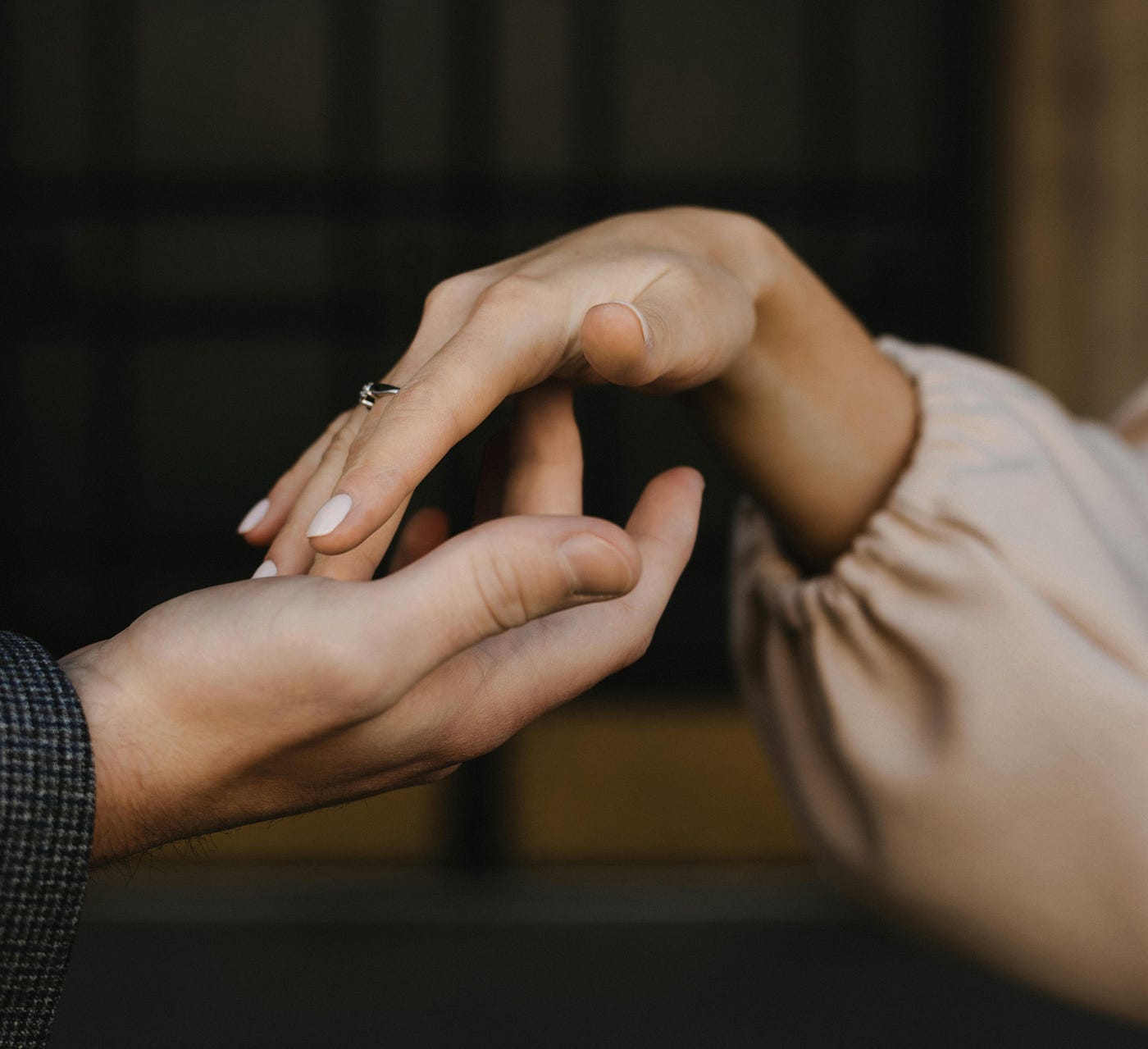
When touch is genuine, consistent, and rooted in care, its impact is undeniable. It builds connection through repetition. Through reaching without thinking. Through choosing closeness on ordinary days. It becomes part of how a relationship breathes.
Relationships don’t usually end in explosions. They drift. Quietly. When touch becomes deliberate instead of instinctive. When closeness feels like effort instead of reflex.
In a world obsessed with grand declarations, intimacy often survives in whispers.
A squeeze of the hand.
A kiss placed absentmindedly on a temple.
A body leaning into another on the sofa — not for warmth, but for nearness.

These gestures may seem insignificant, but they carry weight. They reassure us of our place in someone’s life — not through promises, but through presence.
Because intimacy, at its core, isn’t about intensity. It’s about continuity.
And when touch doesn’t flow — when it feels forced, absent, or uncertain — letting go isn’t failure. It’s simply making room for the love that will.